A Page Table for Tokens
The KV cache we paid for, and the KV cache we used.
Go and measure what a real service actually produces. The mean request runs to about 350 tokens. Not 2048. Three hundred and fifty.
That is a sixth of the length the last two chapters budgeted for, so the card ought to hold something in the neighbourhood of four hundred sequences.
It holds 66.
A budget that cannot go down is not a budget. It is a bill.
It held 66 back when requests averaged 2048 tokens, and it holds 66 now that they average 350. The budget did not notice that the work got smaller, and I find that a genuinely strange thing for a budget to do.
Those figures are chapter 8's: 512 KB per token, 1 GB per 2048-token sequence, and 66 GB of free memory holding about 66 of them. Chapter 9 then taught those 66 slots to release themselves the moment they finish. Neither chapter ever priced a sequence that stops early.
10.1 Candidates and the Ratio
Either the number is right and our expectation was wrong, or the number is wrong and something is being wasted. Both are respectable positions until we do the arithmetic.
The first: 512 KB per token is simply what it costs, the requests are longer than we think, and 66 is the honest answer.
The second: we are paying for tokens that do not exist.
The ratio between those is the ratio between 2048 and 350, which is about six. That is well past the point where it is worth an hour to find out which one is true, and the two answers point at completely different purchases. One says buy memory. The other says stop wasting the memory you already have.
10.2 The Axioms
The reason the budget cannot notice that requests got shorter is that it is committed before the first token is ever generated.
| Quantity | Value |
|---|---|
| KV cache per token, 7B fp16 | 512 KB |
| Maximum context we must support | 2048 tokens |
| Reserved per sequence at admission | 2048 × 512 KB = 1 GB |
| Mean tokens actually generated | ~350 |
| Actually used per sequence | 350 × 512 KB = 175 MB |
That middle row is the axiom, and like chapter 9's it is a choice wearing the costume of a law. Let me take it apart, because three separate facts conspire here and none of them looks like a problem on its own.
A sequence's KV cache has to be contiguous, because attention strides through it as a single tensor. It has to be allocated before generation starts, because we cannot move it afterwards without invalidating every pointer into it. And its final size is unknowable at admission, because the model decides when to stop and it has not decided yet.
Reserved for a conversation nobody had, in the most expensive memory anybody sells.
Three reasonable facts. Put them together and the allocator's hand is forced: reserve the worst case, or risk running out mid-sequence with nowhere to grow.
10.3 Doing the Division
So put the reservation next to the reality. One line for what every sequence is charged at admission, one for what it turns out to need, and the gap between them is the whole problem:
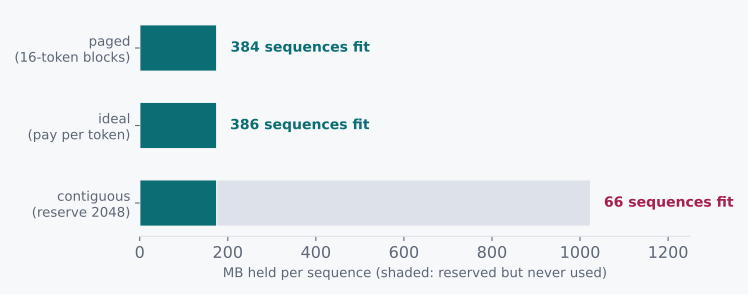
reserved per sequence  =  2048 tokens × 512 KB  =  1024 MB
used per sequence      =   350 tokens × 512 KB  =   175 MB

waste  =  1 − 350/2048  =  83%
Eighty-three percent of the most expensive memory in the building, held against tokens that were never generated and never will be.
The vLLM paper measured this across real serving traces and put the figure between 60% and 80%, so our 83% is the high end of an entirely ordinary range rather than some pathological case I constructed to make a point.
And now, if you squint at the problem rather than at the vocabulary, the answer becomes visible. Because this is not a new problem.
The Atlas computer shipped virtual memory in 1962. The paper reinventing it for attention came out sixty-one years later.
A resource that must appear contiguous to whoever is using it, whose final size is unknown when you allocate it, handed out to many processes at once. That is the problem operating systems solved in 1961. And the answer then was to stop making physical contiguity a requirement at all.
So: chop the KV cache into fixed-size blocks, sixteen tokens each. Give every sequence a small array mapping its logical block index to whichever physical block it happened to get. Allocate a block when the sequence grows into it, and not one step sooner.
blocks needed for 350 tokens  =  ceil(350 / 16)  =  22 blocks
allocated                     =  22 × 16 tokens  =  352 tokens
waste                         =  2 tokens
Two tokens. Against 1698 under reservation.
The waste is now bounded by the block size instead of by the context limit, which is to say it is bounded by a number we chose rather than a number the model chose. That is the whole difference, and it is worth more than it sounds.
10.4 What This Rules Out
This rules out buying memory, on economics rather than principle.
A card with twice the memory takes our 66 sequences to 132, at GPU prices, while leaving 83% of both cards idle. Fixing the allocator gets us to 384 on the card we already own. When a resource is 83% wasted, the return on buying more of it is seventeen cents on the dollar, and that ratio holds no matter how much of it you buy. You cannot purchase your way out of a waste fraction.
Seventeen cents on the dollar, and the ratio is politely indifferent to how many dollars you bring.
It also rules out a subtler instinct, which is to shrink the context limit. Dropping the maximum from 2048 to 512 genuinely would cut the reservation by four. It would also break every request that needed more than 512 tokens, which is a product decision smuggled into a memory optimization, and those are the worst kind of decision because nobody is in the room to object. Paging gets the same memory back without ever telling a user their conversation is too long.
What survives is the indirection, and it pays a second dividend that has nothing to do with waste.
Once a sequence's cache is a list of block pointers instead of a contiguous range, two sequences can point at the same block. A prompt that many requests share, the system prompt every conversation starts with, gets computed once and pointed at by all of them. Refcount the blocks, copy on write when a sequence diverges, and prefix sharing falls out of the very same table we built to fix fragmentation.
You go in to fix fragmentation and come out holding prefix sharing. Nobody planned that, and everybody takes the credit.
That is the sign of a good structure, incidentally. You build it for one reason and it hands you a second thing you were not asking for.
10.5 The Pictorial
Two sequences, sixteen tokens to a block, sharing a system prompt they both begin with:
  seq A logical:  [ 0 ][ 1 ][ 2 ][ 3 ]
  block table A:    7    3    9   12
                    |    |    \    \
  physical pool:  [ 7 ][ 3 ][ 9 ][12 ][ 4 ][ 1 ] ...
                    |    |    /
  block table B:    7    3    4
  seq B logical:  [ 0 ][ 1 ][ 2 ]

  blocks 7 and 3 are the shared prompt: one copy, refcount 2
  logical order is contiguous; physical order is whatever was free
The left half of each sequence is literally the same memory. Neither sequence can tell, and neither one ever sees a physical address.
Challenges
-
Block size 16 is the standard default. Compute the average internal fragmentation per sequence at block sizes 1, 16 and 256, then say what goes wrong at each end. One of the two failure modes is not about memory at all.
-
Chapter 9's challenge 4 asked how to decide whether a newly arrived request can be admitted. Paging changes the answer: a sequence now needs one block to start rather than 1 GB. Write the admission rule, and then find the failure it introduces, which is that a sequence admitted cheaply can run out of blocks halfway through generating.
-
Two sequences share a block by refcount. One of them generates a token that lands in that shared block. Describe exactly what must happen, in what order, and what goes wrong if the refcount is decremented after the copy instead of before.
-
Prefix sharing needs to recognise that two requests begin with the same tokens. Hashing each block's contents is the obvious approach. Work out why hashing a block's own tokens alone is not enough, and what else has to go into the hash. (The failure this prevents is a correctness bug and a privacy bug at the same time.)
Design Note: The Answer Was Sixty Years Old
PagedAttention is a 2023 paper about a 2023 problem, and its central idea is virtual memory, which shipped in the Atlas computer in 1962.
The mapping is not an analogy the paper reaches for in the discussion
section to sound erudite. It is the design. Blocks are pages. Block
tables are page tables. Sharing is fork. Divergence is
copy-on-write. Running out is a page fault, handled by eviction.
There is something in that worth more than the specific trick.
The KV cache problem arrived looking like a machine learning problem, and it was wearing all the machine learning clothes: attention, tokens, transformers, hardware nobody had five years earlier. Solve it as a machine learning problem and you get machine learning answers, and the field did try those first. Smaller caches. Shorter contexts. Cleverer padding. All reasonable. All small.
But describe it in its own terms and it is a memory allocator with unpredictable per-client growth against a hard ceiling. That description has sixty years of prior work bolted to it, and the prior work is better than anything you or I would derive from scratch in a quarter, because a great many careful people already spent their careers on it.
The skill being exercised there is not knowing about paging. Most working engineers know about paging. It is noticing, while surrounded by transformer vocabulary, that the thing in front of you has a shape you have seen somewhere before.