The Slot That Waited
Eight sequences in flight, and one of them doing all the work.

Size the batch at 64, fill every slot, and go and look at the throughput counter with some optimism.
It reads like a batch of sixteen.
Now, everything checks out. Every slot is occupied. Memory is full. The scheduler reports 64 live sequences and nothing is queued. And we are getting a quarter of the tokens per second that chapter 7's arithmetic promised for a batch that size.
The 64 was not a guess, incidentally. It is chapter 8's number: on an 80 GB card the KV cache holds about that many, so we took it at its word and filled every slot it would give us.
Nothing in the last two chapters explains a factor of four. So let's go find it.
9.1 Candidates and the Ratio
Two explanations fit what we are seeing, and it is worth separating them carefully, because one of them is a bug and the other is a decision we made on purpose without noticing.
The first: chapter 8's budget was optimistic. Activations, workspace and fragmentation ate more than the couple of gigabytes we waved at, so we are not really running 64 sequences. We are running sixteen and misreporting it.
The second: all 64 slots really are occupied, and most of them are occupied by sequences that finished a while ago.
It is worth separating those carefully, because they have opposite fixes. The first is a memory-accounting bug, and you solve it by measuring more carefully. The second is not a bug at all. It is a consequence of how we decided to schedule, and no amount of careful measurement will shift it by a single token.
9.2 The Axioms
Here is the thing chapters 7 and 8 never priced: sequences do not finish together.
Two of them, sitting side by side in the same batch, can differ in output length by two orders of magnitude, and neither one is unusual.
| Quantity | Value |
|---|---|
| "What is 2+2?" | ~5 output tokens |
| "Explain the CAP theorem" | ~400 output tokens |
| Ratio between them | ~80× |
| A batch, once launched, runs until | its slowest member finishes |
That last row is doing all the damage, and I want to point at it directly, because it is a choice dressed up as a law.
"What is 2+2?" and "Explain the CAP theorem" are billed at the same rate, and one of them is subsidising the other rather heavily.
We launch a batch. We run it to completion. We launch the next one. That is the obvious way to write the loop. It is how you would write it on a whiteboard, it is how every framework wrote it the first time, and there is nothing wrong with it except what it costs.
9.3 Doing the Division
Take eight requests with a spread any real service would call a quiet afternoon, and count the slot-steps we bought against the slot-steps we used. A slot-step is one sequence occupying one batch slot for one forward pass. It is the atomic unit of the thing we are actually paying for.
output lengths        =  5, 8, 6, 120, 7, 9, 6, 11
batch runs for        =  max(lengths)          =  120 steps
slot-steps purchased  =  8 slots × 120 steps   =  960
slot-steps used       =  5+8+6+120+7+9+6+11    =  172

occupancy  =  172 / 960  =  18%
You bought eight seats and one passenger. The airline model, applied to compute.
Eighteen percent.
We provisioned a batch of eight and got the throughput of roughly one and a half. Scale the same distribution up to 64 slots and the shortfall is the factor of four we measured, with room to spare.
If you carry one number out of this chapter, carry occupancy rather than batch size. Batch size is what you configured. Occupancy is what you bought, and nobody puts it on a dashboard.
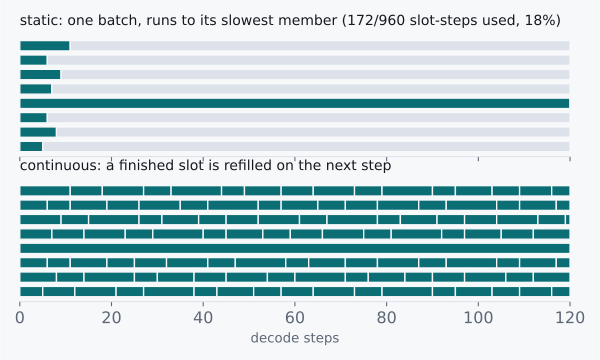
Look at the top half of that picture for a moment. Seven of the eight lanes go dark inside the first eleven steps and then just sit there, dark, for another hundred and nine, while one long sequence grinds to the end.
Batch size is what you configured. Occupancy is what you bought. Only one of them is on the dashboard, and it is the wrong one.
The slots did not fail. They finished. And then they waited, because we never built them a way to leave.
9.4 What This Rules Out
This rules out the memory-accounting candidate, and it rules it out cleanly, because the arithmetic above never mentions bytes. Not once.
You can hand the scheduler a perfectly measured 64-sequence budget and still get 18% occupancy, because the waste is in time, not space. Every fix aimed at memory (a tighter budget, less fragmentation, a bigger card) leaves that number exactly where it is.
It also rules out the reflex to blame padding, which is where most people go first, myself included.
Padding is real. Shorter prompts get padded up to the longest one in the batch, and those padded positions cost attention work. But padding is bounded by the spread in prompt lengths within a single step, which is a small constant. What we just measured is bounded by the spread in output lengths across the batch's whole lifetime, which is 80×. Those are not the same problem and they are nowhere near the same size, and if you spend a week on the first one you will move the second one by nothing.
Padding is the wrong suspect, and it has the enormous advantage of being easy to arrest.
What survives is the second, and the fix falls straight out of it. If the loss comes from a finished sequence holding a slot, then let it go. After every forward pass, ask which sequences emitted an end-of-sequence token, evict them, and admit whatever is queued into the space they left behind.
The batch stops being a fixed group of requests that start and end together, and becomes a running set that sequences join and leave continuously.
The idea comes from Orca (OSDI '22), where it is called iteration-level scheduling, and it is the largest single throughput win in modern inference serving. Not because it makes any kernel faster. Not one kernel changed. Because it stops us renting slots to sequences that finished their work and had nowhere to go.
9.5 The Pictorial
The mechanism fits in a loop short enough to read in one breath:
every forward pass:
    admit    while len(running) < max_seqs and queue is not empty:
                 prefill the next request, splice it into the batch
    harvest  record each running sequence's newest token
    evict    drop the ones that hit EOS or their token budget
    forward  one single-token pass over whatever survived
The largest throughput win in modern inference serving is four lines long and swaps the order of two of them.
Four steps. And the order of the middle two is the entire chapter. Evict before the forward pass and a finished sequence costs you nothing. Evict after it, or at the end of the batch like we used to, and you are back at eighteen percent.
Challenges
-
The loop above evicts finished sequences before the forward pass. Work out what happens to a request's output if you evict after it instead, and say precisely which token goes missing.
-
Admitting a new request means prefilling its prompt and splicing that prompt's KV into a batch whose sequences are all at different lengths. Sketch the tensor operations that requires, and estimate how much copying happens per admission. Then say what the copy cost is proportional to, and why that makes admission expensive at exactly the moment you want it to be cheap.
-
With the loop above and a 64-slot budget, what workload would still produce low occupancy? Describe the output-length distribution that defeats iteration-level scheduling, and say whether you think it occurs in practice.
-
A request arrives while the batch is full. Iteration-level scheduling says it waits for a slot. Chapter 8 says slots are bounded by KV memory, not by a count. Design the admission rule that decides whether a newly arrived request can start, given that you do not know how long it will run. (Nothing above answers this; the next chapter changes the memory model underneath it, which changes the answer.)
Design Note: The Cheapest Optimizations Are Refusals
Nothing in this chapter made anything faster.
I want to be precise about that, because it is easy to skim past. No kernel changed. No byte moved sooner. No arithmetic got cheaper. We found a place where the system was doing work it did not have to do, and we stopped doing it.
That is worth noticing, because it is the pattern behind most of the large wins in this book. Group commit did not make fsync faster, it stopped calling it once per writer. Write-ahead logging did not make the disk quicker, it stopped waiting on data pages before acknowledging. Here we did not make decoding faster, we stopped renting slots to sequences that had already gone home.
The engineering instinct, faced with a throughput number that is four times too low, is to go looking for something to speed up. That instinct is strong and it feels productive and it is usually the second best thing to do.
Spend an hour first on the less flattering question: what is this system doing that it does not need to do at all? The answer tends to be cheaper to implement and larger in effect than whatever you were about to optimize, and it has the rare and pleasant property that the code gets shorter.