Spending the Idle
Five tokens for the price of one, and no asterisk.
Here is a measurement that ought to be impossible.
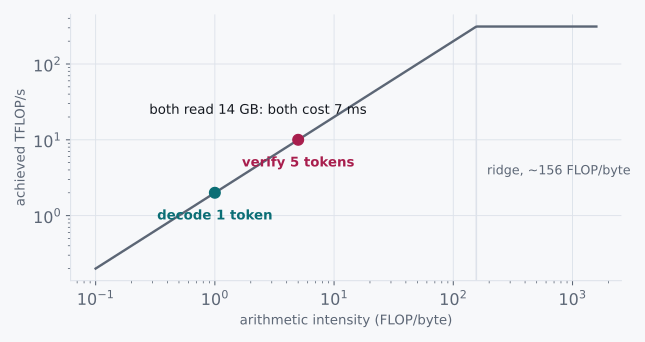
Take five candidate tokens, produced by something cheap. Hand all five to the 7B model and ask it to check them in a single forward pass. Five times the arithmetic of an ordinary decode step.
Five times the work at the same price. This is the one place in the book where that sentence is not a warning.
It takes the same 7 milliseconds.
Chapter 7 opened this book's second half with a complaint about exactly the resource that just paid for those five tokens. Generating one token from a 7B model on an A100 spends 45 microseconds computing and 7 milliseconds waiting, and the most expensive processor in the building sits 99.4% idle. Five chapters later we have moved an enormous amount of memory around and never once gone back for it.
12.1 Candidates and the Ratio
That should not be possible, so one of our assumptions is wrong. Either the work we just did was not the work we thought, or it was genuinely free, and only one of those is good news.
The first: the check is not a real check. We are approximating, sampling from something that is not quite the model's true distribution, and the five tokens we get are not the five the model would have produced. Faster and slightly wrong is an old trade, and usually a bad one.
The second: the arithmetic was free, because we had already paid for it and were not using it.
The ratio worth naming is 156 to 1, and we computed it back in chapter 7. If the second is right, then this is not a clever trick at all. It is the natural consequence of standing two orders of magnitude to the left of the ridge, and the only surprising thing is that it took the field until 2023 to go and spend the change.
12.2 The Axioms
Everything we need is already on the table from chapter 7, which is a good sign for a final chapter.
| Quantity | Value |
|---|---|
| Weight bytes read per forward pass | 14 GB, independent of token count |
| FLOPs per token of work | ~14 GFLOP |
| A100 ridge point | ~156 FLOP/byte |
| Memory time for one pass | ~7 ms |
| Compute time per token of work | ~45 µs |
That first row carries the chapter, so let me say it in words too. A forward pass over K tokens reads the weights exactly once, in precisely the way a forward pass over one token does, because the weights have no idea how many tokens are passing through them.
The weights have no idea how many tokens are passing through them, and knowing would not help them in the slightest.
Which is the same fact chapter 7 used to justify batching, applied along a different axis. Batching puts K different sequences through one weight read. This puts K consecutive tokens of one sequence through it.
12.3 Doing the Division
Then the comparison is two lines of arithmetic, and the second one is just the first with a bigger numerator. Same bytes read, five times the operations:
generate 1 token   :  14 GB read,  14 GFLOP  →   1 FLOP/byte
verify 5 tokens    :  14 GB read,  70 GFLOP  →   5 FLOP/byte

ridge point        :                            156 FLOP/byte
Both sit far to the left of the ridge. So both are memory-bound. So both cost exactly what the memory costs:
memory time, either case  :  14 GB ÷ 2 TB/s   =  7.0 ms
compute time, generate 1  :  14 GFLOP ÷ 312 TFLOP/s  =   45 µs
compute time, verify 5    :  70 GFLOP ÷ 312 TFLOP/s  =  225 µs
Doing five times the arithmetic for free is the closest thing to a free lunch in this book, and it took the field until 2023 to order it.
The compute grew by a hundred and eighty microseconds, against a seven millisecond wait. We went from 99.4% idle to 96.8% idle and the wall clock did not move, because at 5 FLOP/byte we are still thirty-one times short of the ridge.
Chapter 7 told us extra compute below the ridge buys nothing. Read that sentence the other way round and it says extra compute below the ridge costs nothing, and that is the whole chapter.
12.4 What This Rules Out
That leaves candidate one, and it is the interesting one to set aside, because the mechanism that does it is genuinely surprising.
The naive way to use five proposed tokens is to accept the ones that match what the model would have picked and stop at the first that does not. Under greedy decoding that is already exactly right. Under sampling it is subtly wrong, because "matches the most likely token" is not the same thing as "drawn from the model's distribution," and a system that quietly sharpens its own sampling is precisely the quality-for-speed trade we were trying to avoid.
Modified rejection sampling repairs it, and here is the whole of it.
Let q be the cheap proposer's distribution and p the real model's. For each proposed token t, accept it with probability min(1, p(t) ÷ q(t)). On rejection, draw the replacement not from p, but from the normalized residual max(0, p − q), and stop there.
That residual is the part that makes it exact, and it is worth understanding rather than memorizing. Accepting at min(1, p/q) alone under-samples the tokens the proposer thought unlikely. Sampling rejections from p − q puts back exactly the mass that step removed. Not approximately. Exactly.
The tokens that come out are distributed according to p. Not close to p. Not p within a tolerance. p.
Lossless and merely-fast produce text that reads exactly alike. Only one of them survives a statistician.
If you only remember one line of algebra from this chapter, make it that subtraction. It is the difference between a technique that is lossless and one that is merely fast, and you cannot tell them apart by reading the output.
So a bad proposer costs speed and never quality. That is a rare shape for a trade-off and worth stating plainly: the failure mode of speculative decoding is that it stops helping.
It also rules out reaching for a large K. If each token is accepted with probability a, then the expected yield of one target pass is one guaranteed token plus the accepted run:
expected tokens per pass  =  1 + a + a² + ... + a^K

at a = 0.7:   K=4 → 2.77      K=8 → 3.19      K=16 → 3.32
Eight consecutive correct guesses is an optimistic afternoon, and 0.7 to the eighth power agrees.
Doubling K from 4 to 8 buys 0.42 tokens, because reaching the eighth proposal requires eight consecutive acceptances, and 0.7 to the eighth is a small number. Past K of about four to eight you are paying draft cost for tokens you will throw away, and eventually paying enough of it to matter even down here below the ridge.
12.5 The Pictorial
Where the proposals come from is almost an afterthought, which I take as the best evidence that this idea is really about the ridge and not about owning a second model.
  n-gram proposer, no model at all:

    context:  ... def fibonacci(n):  if n < 2:  return n   def fib
    search backwards for "def fib" ---^                    ^-- match
    propose what followed last time:  onacci(n):  if n < 2:

  target model verifies all five in one 7 ms pass
  accepts the longest correct prefix, corrects the first miss
For code, for structured output, for anything that quotes its own prompt back, that costs nothing and hits often. A small draft model does better on prose and costs a fraction of a pass. Either way the expensive model runs once and returns several tokens, and the idle compute from chapter 7 is what pays for all of it.
Challenges
-
Verification at K=5 sits at 5 FLOP/byte. Speculation and batching compose: a server running batch 32 with K=5 verification is at some intensity you can compute. Work it out, compare it to the ridge, and say whether the two techniques are still free when used together.
-
Derive the expected-tokens-per-pass formula in 12.4 from the acceptance probability a, rather than taking it on trust. Then find the K that maximizes tokens per pass once you charge the draft model at 5% of a target pass per proposed token.
-
Acceptance rate a is not a constant. Predict whether a is higher when the model is generating code or generating poetry, justify it in terms of the target's output distribution, and say what that implies about advertising a single speedup number for this feature.
-
Chapters 7 through 12 give four ways to move throughput: batch, page the cache, delete launch overhead, and speculate. A serving system has finite engineering time. Order them for a deployment whose requests average 30 output tokens and arrive 4 per second, and justify the order with arithmetic rather than preference. (Nothing above answers this; the arrival rate changes which wall you are against.)
Design Note: The Idle Was the Budget
Chapter 7 computed 99.4% idle and treated it as an indictment. It read like waste. Like something a better engineer would have prevented. The natural response was to go looking for the mistake that caused it, and I sent you looking, and there was no mistake.
Six chapters later the same number is a budget.
The GPU is idle because arithmetic intensity is far below the ridge, and that is not a defect waiting to be repaired. It is a resource sitting unspent. Speculative decoding is the first technique in this book that treats it that way. It does five tokens' worth of arithmetic to produce, on average, fewer than three useful tokens. It throws the rest away. And it comes out ahead, because the arithmetic was never the scarce thing.
Which is the argument the whole book has been making, arriving at last in a form specific enough to be uncomfortable. Every chapter here has been about finding the one quantity that is genuinely scarce and declining to optimize the others. In chapter 3 it was the fsync round trip and not the bytes. In chapter 8 it was memory capacity and not compute. Here it is bandwidth, and the correct response to a scarce resource is to spend the abundant ones freely, including on work you fully expect to discard.
The uncomfortable part is that this reverses what good engineering feels like. Doing arithmetic you know will be thrown away, deliberately, at a ratio of five to three, offends an instinct most of us have been rewarded for having our entire careers. And that instinct is correct, whenever compute is scarce. It is precisely wrong here. Telling those two situations apart is what the ratio in chapter 7 was always for.
That is where this book stops deriving and the course starts building. Twenty stages, each gated on a measurement rather than on your code merely running: the naive loop, the KV cache, the roofline you just read about, static and then continuous batching, the block allocator, paged attention in PyTorch and then in Triton, prefix caching, the scheduler, chunked prefill, CUDA graphs, the sampler, the detokenizer, the server, and the rejection sampler from this chapter.
The chapters tell you which number matters and why. The stages will not let you past until your version of it moves.